
How to Search Copiah County Criminal Dockets
Start with the paper you already have. Pull the charging document, the citation, a hearing notice, or an old order. A Copiah County felony may have moved into Mississippi Circuit Court. It can show up through Public Access to MEC, or PAMEC. That system is read-only public access to participating electronic court files. Misdemeanors, affidavits, preliminary hearings, and local citations often stay with Justice Court instead. City cases belong to the municipal clerk for the issuing city. The county offers no official bulk criminal portal.
Search with the narrowest facts you have. A case number plus the court name works best. Without a number, give the clerk a full name. Add an approximate filing date, the charge level, or a hearing date. PAMEC requires a registered account. Its published terms charge $10 for annual registration plus $0.20 per page returned. Even a zero-result search costs one page. Check the spelling and the court before running a broad search again.
- Read the notice or record for the court, case number, and filing or hearing date.
- For a Circuit Court matter, register for PAMEC and choose the participating Copiah court.
- Search by case number first, then use a carefully narrowed name search if needed.
- Open the docket sheet and note the case status, filings, settings, and any access flag.
- For Justice or municipal matters, call, mail, or visit the responsible clerk and ask about the public record or courthouse viewing option.
Note: PAMEC bills by the page returned, so confirming the court and case number first can save you from paying twice for the same search.
Copiah County Criminal E-Cite Workflow
A Copiah County job posting for a criminal deputy clerk explains the reason. It shows why the first court matters so much. The Justice Court workflow covers loading e-cite tickets. It takes in affidavits, enters fines and disposition dates, and receipts online payments. The clerk also sets contested hearings and call dates for both Justice Court judges. That is the clerk-assisted criminal workflow. It does not mean every Justice Court record has a public online search screen. The Copiah County criminal deputy clerk description is the local source for this mix of paper and electronic steps.
An active court record can exist early. Because of that workflow, a citation or affidavit may precede its own appearance in any statewide Circuit search. If PAMEC returns nothing, call Justice Court first. Do that when your Copiah County case has a hearing coming up and the matter began as a citation, misdemeanor, or felony affidavit. The clerk can confirm the court, the call date, and how to make a request. A case that moves by bindover later follows a separate Circuit Court record path.
What a Criminal Docket Shows
Think of a Copiah County criminal docket sheet as a chronological index. It lists what happened. It is not a promise that every document opens remotely. The Circuit Clerk's general-docket duties cover parties and pleas. They reach indictments, appeals from inferior courts, papers, orders, an execution docket, and the complete record of proceedings. An entry usually starts with the court, case number, filing date, case type, and caption. From there, entries may record an indictment or affidavit. Later entries can show bond, arraignment, plea, motions, hearing settings, judgment, costs, appeal, or closure.
| Case number | The court-assigned key. A local sample shows year-number patterns with a KR criminal suffix, but the clerk should confirm any format. |
|---|---|
| Initiating record | An affidavit, indictment, citation, or other filing that starts the criminal court record. |
| Settings | Entries for arraignment, motions, plea, trial, or another scheduled court event. |
| Status or flag | A displayed indicator such as CLOSED, BOUND OVER, TRIAL PENDING, SEALED, or EXPUNGED. It is not a full legal explanation. |
| Disposition | The recorded outcome, if any, together with judgment, sentence, costs, appeal, or other closing activity. |
The local Circuit CourtInfo display helps you check the system's date, public-access links, and the flags it recognizes. Its Copiah Circuit MEC CourtInfo page lists the operating host as Twenty-Third Circuit, though the current statewide directory uses a different district label. Because of that mismatch, the individual court and case number are the safer search anchors.
Copiah County Criminal Docket Flags
Flags make a Copiah County search result easier to sort, but read them with restraint. BOUND OVER is one example. It can mean a lower-court felony moved toward grand-jury or Circuit Court processing. TRIAL PENDING and PLEA PENDING point to an unfinished stage. CLOSED does not end the story. It usually means no active proceeding in that docket view, not the full history of every related matter. SEALED, Sealed_Case, and EXPUNGED mark restrictions that change what can be viewed.
LegacyCase, Legacy Complete, Legacy Incomplete, and ELECTRONICBOOK are Copiah County system labels. They reflect migration or record-storage status. A missing image can mean several things. It might be a conventional document, exhibit, older paper record, or restricted item that needs clerk review. Preserve the displayed code exactly. Copy it as the Copiah County MEC page shows it. Never guess at an unexplained code like SM.
The Circuit CourtInfo display holds the official list of local-facing flags. A clerk can tell you what public material, if any, goes with a particular flag.
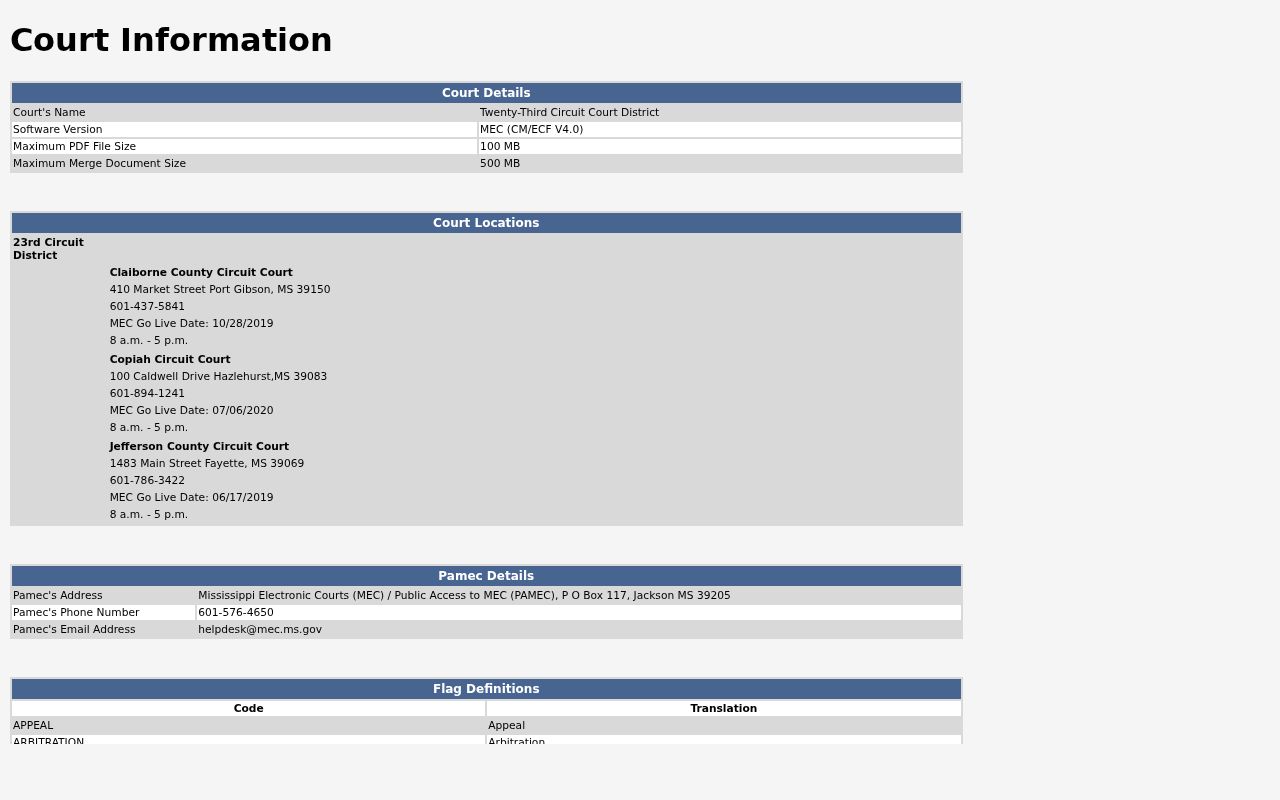
The CourtInfo screen helps distinguish a system-status page from a case-specific criminal docket sheet.
Stages on a Copiah County Criminal Docket
A criminal case moves in stages, and each stage can add a new docket entry. In Copiah County, a matter often begins in Justice Court. It usually starts with a citation or affidavit. A felony affidavit can lead to an initial appearance and a bond proceeding. A preliminary hearing may be requested when the person is not bonded. A bindover or indictment changes that. The Circuit Court docket then becomes the main record for filings and settings.
Docket flow: Filing → Arraignment → Pretrial → Plea or Trial → Disposition → Sentencing
On a Copiah County criminal docket, arraignment, motion, trial, plea, and sentencing are separate events. A status flag tells you very little. It can't replace the dated docket line itself. Copiah County's local criminal procedure materials explain that the court sets arraignment dates, which then appear on the local court calendar. So check the court record first. After that, confirm the date with the clerk who handles the case.
Copiah County Criminal Bindover Records
Felony records in Copiah County live in one court at a time. Justice Court handles the early stages: the affidavit, bond, and the preliminary hearing. Copiah County describes this path in its own materials. A bindover then moves the case toward the grand jury and Circuit Court processing. The local bound-over attorney notice form shows the handoff. It names the originating lower court and a Circuit Court submission route.
That split shapes how a docket search should work. Start with the court holding the case now, not the one that first received it. Need a current Circuit filing? The Circuit Clerk and PAMEC are the key channels. An unresolved Justice Court date calls for the Justice Court Clerk instead. Local Circuit procedure also directs eligible electronic court filings through MEC. The clerk plays a role in docketing signed orders.
Which Court Holds Criminal Dockets
Which office holds a Copiah County criminal record depends on the charge. Mississippi Circuit Court serves as the general criminal trial court. It handles felonies and related Circuit proceedings. Justice Court tries misdemeanors. It also handles felony initial appearances, bond, affidavits, preliminary pathways, and county traffic matters. Municipal courts keep the dockets for their own city traffic, ordinance, and limited criminal cases. One office sits outside this lineup: the District Attorney, who prosecutes felonies for Copiah, Claiborne, and Jefferson Counties. That office is not the general record custodian. Know the charge before you call.
Circuit Clerk
Derrick Cubit maintains the Circuit general docket and related court records.
100 Caldwell Drive, Hazlehurst, MS 39083
P.O. Box 467, Hazlehurst, MS 39083
601-894-1241
Justice Court Clerk
Mona Lisa Carr is the clerk route for Justice Court criminal, hearing, and citation records.
121 W. Frost Street, Hazlehurst, MS 39083
P.O. Box 551, Hazlehurst, MS 39083
601-894-3218 or 601-894-4403
The county publishes official contacts for the Circuit Clerk and Justice Court. A city case works differently. Read the city printed on the ticket or notice, then contact that municipal clerk rather than assuming the county clerk holds the record.
Copiah County Criminal Clerk Access
PAMEC isn't the only route to a Copiah County criminal record. The clerk offers a practical fallback chain. Reach the office by phone, by mail to its published post-office box, or in person. Ask early whether the office takes requests by fax or email. Ask, too, what access looks like. It might be a public terminal, a paper file, clerk-assisted retrieval, or a docket-only view. Have the court, case number, party name, approximate date, and document type ready. For a large file, ask about the current copy or certification amount before requesting it.
Two offices cover most needs. Circuit Court sits at 100 Caldwell Drive, where Derrick Cubit's office answers at 601-894-1241. Justice Court is located at 121 W. Frost Street. Its numbers, 601-894-3218 and 601-894-4403, are listed by the county. Mail your request to the correct custodian. Include clear contact information. Add payment only if the office instructs it. The county offers no official criminal bulk-download channel. For statewide help, the Mississippi Judicial Directory and MEC help information are useful references. Neither replaces the clerk's case-specific confirmation.
Public Access and Sealed Criminal Dockets
Public access to a Copiah County criminal docket does not mean open remote access to everything in the file. Not everything appears online. Under Copiah County PAMEC terms, docket sheets and documents appear only in non-restricted cases. The Circuit and Justice clerks stay the right contacts for a lawful access determination. They also handle public-terminal availability, paper records, or a redacted copy. A clerk may confirm a limited index entry while withholding a protected document. Both things can be true at once.
Youth-court records in Copiah County face especially tight restrictions. Other files may involve an expungement or a sealed order. Some involve protected personal information, a minor-child issue, DHS material, an adoption, a commitment, or a protective order. Ask the clerk for the statutory, rule-based, or order-based reason behind any restriction. Ask as well whether docket-only or redacted access exists. A search result is never permission to bypass the court's access controls.
Access rules:
Mississippi Code Title 25, Chapter 61 describes the state public-records framework, but judicial docket access can be governed by court policy and court rules.
Mississippi judicial public-records policy is the judicial-policy source identified for court-record access.
Mississippi Code § 43-21-261 is the youth-court confidentiality provision referenced in the official research materials.
Copiah County Criminal Docket Limits
A Copiah County criminal docket records court activity, but not all of it. Some exhibits, unscanned conventional filings, and protected documents never appear there. Local procedure lets a signed order be mailed or hand-delivered to the Circuit Clerk for docketing, so filing and online visibility can happen at different moments. That timing gap matters. One empty search proves nothing; check with the clerk before drawing a conclusion.
Read status labels with care. Pending, dismissed, nolle pros, not-guilty, convicted, and expunged each mean something different. The current docket line and any order control over a short label. The local district-name difference between the statewide directory and MEC host is also no reason to guess. When a label could affect your Copiah County criminal docket search, confirm the court, case number, and clerk.
Note: The court and case number are more dependable search facts than a district label or a broad name search.